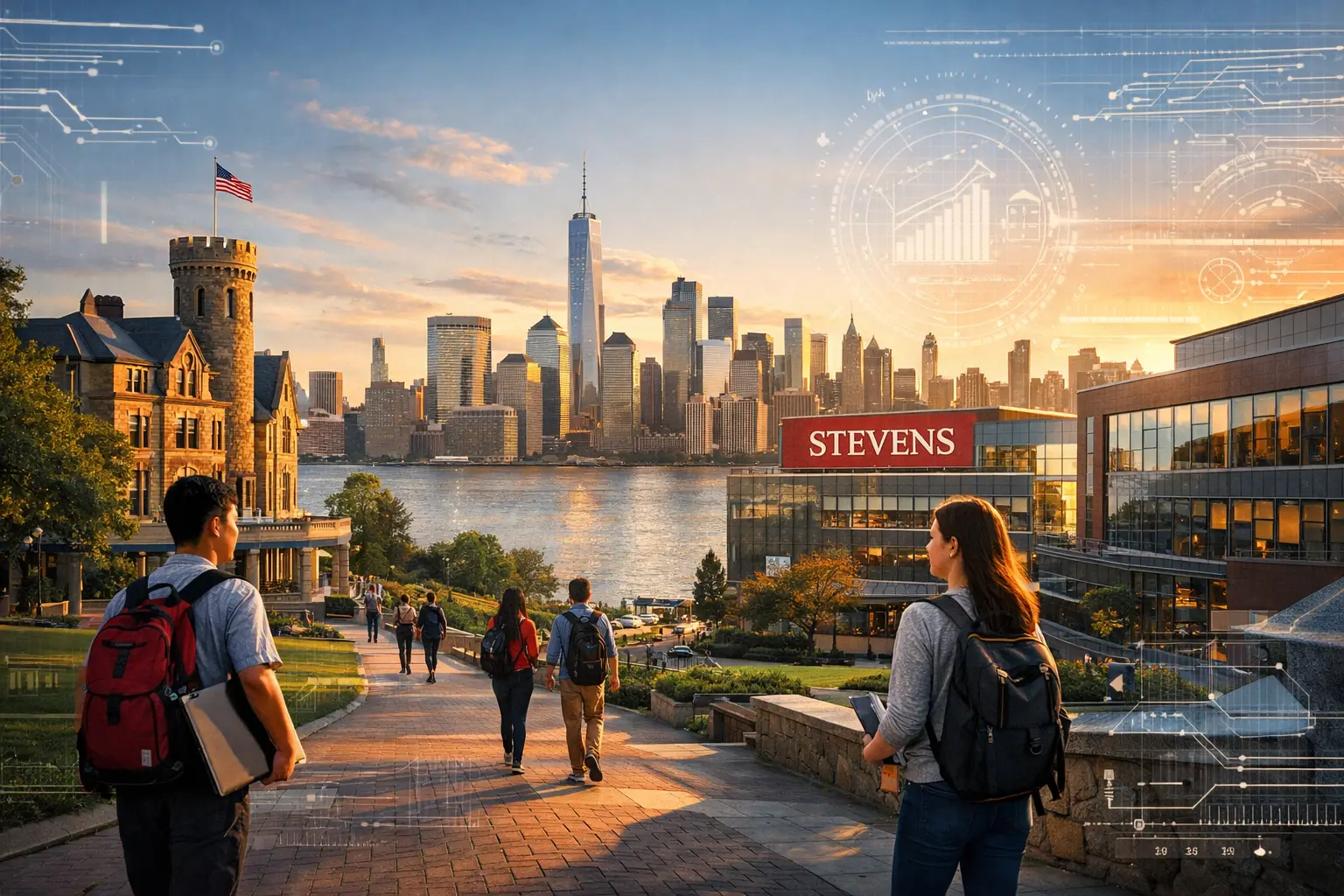
Choosing a university today feels less like picking a school and more like making a long-term investment decision. Tuition is high, competition is brutal, and the job market rewards practical skill far more than academic theory alone. That is exactly why Stevens Institute of Technology keeps showing up in serious conversations among students, parents, recruiters, and even startup founders.
Stevens Institute of Technology sits in Hoboken, New Jersey, directly across the Hudson River from Manhattan. That location is not just a nice postcard view—it fundamentally shapes how Stevens operates, who it attracts, and how its graduates perform in the real world. In an era where universities are often criticized for being disconnected from industry, Stevens has quietly built a reputation for doing the opposite.
This guide is written for students weighing high-stakes decisions, parents evaluating return on investment, professionals considering graduate programs, and anyone trying to understand why Stevens consistently punches above its weight in technology, engineering, business, and innovation. Rather than repeating brochure-level talking points, this article breaks down what Stevens Institute of Technology actually delivers, where it excels, where it struggles, and who it is genuinely best for.
If you want rankings-only summaries, this is not that article. If you want to understand how Stevens works in practice—and whether it aligns with your goals—you are in the right place.
What Is Stevens Institute of Technology? From Beginner Context to Expert-Level Understanding
At a surface level, Stevens Institute of Technology is a private research university founded in 1870, best known for engineering, computer science, and applied technology programs. That description, while accurate, misses what makes Stevens different.
Think of Stevens less like a traditional liberal arts campus and more like a technology-driven ecosystem. The school was founded by the Stevens family—industrial innovators who understood that engineering only matters when it solves real problems. That philosophy still shapes how courses are designed, how faculty teach, and how students are evaluated.
For beginners, Stevens may appear similar to other STEM-heavy universities. You attend lectures, complete labs, work on projects, and earn a degree. But as you move deeper—especially in upper-level undergraduate courses and graduate programs—you start noticing a pattern. Classes increasingly resemble workplace environments. Projects mirror industry deliverables. Professors often reference consulting work, patents, startups, or government-funded research rather than purely academic models.
For advanced learners and professionals, Stevens functions as a bridge between academia and industry. Many programs are structured around applied research, systems thinking, data-driven decision-making, and cross-disciplinary collaboration. Whether you are studying cybersecurity, quantitative finance, mechanical engineering, or technology management, the curriculum constantly asks one question: “How would this be used in the real world?”
This orientation explains why Stevens graduates often transition smoothly into demanding roles at tech companies, financial institutions, defense contractors, and research organizations.
Why Students Choose Stevens Institute of Technology: Benefits and Real-World Outcomes
The real value of Stevens Institute of Technology becomes clearest when you compare outcomes rather than promises. Students do not choose Stevens because it is the cheapest option or the most famous name. They choose it because it tends to deliver measurable results.
One of the most tangible benefits is career alignment. Stevens programs are tightly mapped to in-demand roles. Engineering students graduate having used industry-standard tools. Computer science students work with real datasets, real codebases, and real constraints. Business and technology students learn analytics, systems modeling, and decision frameworks that translate directly into consulting, product management, and operations roles.
Another major advantage is proximity to opportunity. Being minutes from New York City means access to internships, part-time roles, networking events, and guest lecturers that students at remote campuses simply do not get. Many Stevens students intern during the academic year, not just over the summer, giving them a practical edge before graduation.
There is also a strong return-on-investment narrative. While Stevens is not inexpensive, graduates often enter higher-paying fields earlier in their careers. Alumni frequently cite faster promotion cycles, stronger technical confidence, and easier transitions between roles as long-term benefits.
Finally, Stevens offers a smaller, more focused environment. Classes are generally smaller than those at large public universities, which translates to more direct access to professors, research opportunities, and mentorship. For students who thrive in hands-on, performance-driven settings, this can be a decisive advantage.
How Stevens Institute of Technology Works in Practice: A Step-by-Step Look at the Student Journey
Understanding Stevens Institute of Technology requires looking at how a student actually moves through the system, from admission to graduation and beyond.
The journey typically starts with a strong emphasis on fundamentals. First-year students encounter rigorous coursework in mathematics, science, programming, and systems thinking. This phase can feel intense, especially for students transitioning from less demanding high school environments. The workload is real, and time management becomes critical early.
As students progress, coursework becomes increasingly project-based. Labs evolve into team-driven engineering challenges. Assignments shift from problem sets to deliverables—reports, prototypes, simulations, and presentations. This mirrors workplace dynamics and forces students to develop collaboration, communication, and accountability skills alongside technical competence.
Internships and co-ops often run parallel to coursework. Many students leverage Stevens’ location and alumni network to secure internships during the school year. Faculty advisors typically encourage this, helping students align academic choices with career goals rather than treating internships as distractions.
By the final year, most students are deeply specialized. Capstone projects frequently involve industry sponsors, research labs, or real-world datasets. At this stage, Stevens feels less like a classroom and more like a launchpad. Graduates leave with portfolios, references, and practical experience—not just transcripts.
Academic Programs at Stevens Institute of Technology: Where It Truly Excels
Stevens Institute of Technology offers programs across engineering, science, business, and liberal arts, but its reputation is strongest in applied technical disciplines.
Engineering programs are the backbone of the institution. Mechanical, electrical, civil, biomedical, and systems engineering programs emphasize design thinking and applied problem-solving. Students routinely work on projects tied to infrastructure, robotics, energy systems, and manufacturing challenges.
Computer science and cybersecurity are also flagship areas. Coursework blends theory with hands-on development, covering areas like artificial intelligence, machine learning, software engineering, and network security. Graduates are well-positioned for roles in tech firms, startups, and government agencies.
Business and technology programs, including quantitative finance, analytics, and technology management, represent another strength. These programs are particularly attractive to students who want to operate at the intersection of technology and decision-making rather than pure coding or engineering.
Graduate programs deserve special mention. Stevens has built a strong reputation for professional master’s degrees designed for working professionals. Evening, hybrid, and accelerated formats make these programs accessible without sacrificing rigor.
Tools, Resources, and Expert Recommendations for Stevens Students
Students at Stevens Institute of Technology benefit from a robust ecosystem of tools and resources, but knowing how to use them effectively makes a significant difference.
Laboratories and research centers are central assets. From cybersecurity labs to engineering design studios, these spaces provide access to hardware, software, and mentorship that many universities reserve for graduate students only. Undergraduates who proactively seek research opportunities often gain a substantial edge.
Career services at Stevens are particularly industry-oriented. Resume reviews, mock interviews, employer info sessions, and alumni networking events are frequent and practical. Students who engage early tend to see better internship and job outcomes.
Faculty access is another underappreciated resource. Many professors maintain active industry connections or research portfolios. Building relationships through office hours, projects, and research assistance often leads to internships, recommendations, and long-term mentorship.
Expert advice from alumni consistently emphasizes one theme: initiative matters. Stevens provides the tools, but students who treat the experience passively rarely extract full value. Those who seek projects, internships, and leadership roles tend to outperform peers quickly after graduation.
Common Mistakes Students Make at Stevens—and How to Avoid Them
Despite its strengths, Stevens Institute of Technology is not immune to pitfalls. Understanding common mistakes can help students maximize their experience.
One frequent error is underestimating workload intensity. Stevens courses move fast, and falling behind early can cascade into serious stress. Successful students treat coursework like a professional commitment rather than a series of isolated classes.
Another mistake is ignoring networking opportunities. Being near New York City is only valuable if students actively engage. Skipping career events, avoiding alumni outreach, or delaying internships can limit post-graduation options.
Some students also over-specialize too early. While depth is important, Stevens rewards systems thinkers who can communicate across disciplines. Balancing specialization with broader technical literacy often leads to better long-term flexibility.
Finally, students sometimes fail to leverage support systems. Tutoring, advising, mental health resources, and peer networks exist for a reason. Seeking help early is a sign of professionalism, not weakness.
Life at Stevens Institute of Technology: Culture, Campus, and Community
Beyond academics, Stevens Institute of Technology offers a distinctive campus experience. The Hoboken location provides a blend of traditional campus life and urban access. Students enjoy skyline views, green spaces, and walkable neighborhoods alongside immediate access to Manhattan.
Campus culture is collaborative but driven. Students tend to be ambitious, practical, and goal-oriented. Social life exists, but it often revolves around shared projects, organizations, and career interests rather than purely recreational activities.
Clubs and organizations reflect the school’s technical focus, with strong participation in engineering societies, entrepreneurship groups, and research teams. At the same time, arts, athletics, and community service provide balance.
For students who want a classic party-school environment, Stevens may feel subdued. For those who value focus, opportunity, and momentum, it often feels exactly right.
The Long-Term Value of a Stevens Institute of Technology Degree
The true test of any university is not graduation day but what happens five, ten, and twenty years later. Stevens Institute of Technology performs well on this metric because of its emphasis on adaptability.
Graduates frequently report that the skills learned—systems thinking, quantitative reasoning, project execution—remain relevant even as technologies change. Many move into leadership roles, startups, or advanced research positions over time.
The alumni network, while smaller than that of massive universities, is notably engaged. Shared experiences and rigorous training create strong professional bonds that persist across industries.
In a labor market increasingly shaped by automation, data, and complexity, Stevens’ applied, technology-first approach positions graduates to evolve rather than stagnate.
Conclusion: Is Stevens Institute of Technology the Right Choice for You?
Stevens Institute of Technology is not designed to be everything to everyone. It is demanding, focused, and unapologetically practical. For students who want clear career pathways, rigorous technical training, and real-world relevance, it can be an exceptional choice.
If you thrive in hands-on environments, value applied learning, and are willing to take initiative, Stevens offers a powerful platform. If you prefer broad theoretical exploration or a purely traditional college experience, other institutions may be a better fit.
The key is alignment. When your goals match Stevens’ strengths, the results can be transformative.
FAQs
Is Stevens Institute of Technology prestigious?
Yes, particularly in engineering, technology, and applied sciences, where it is well-regarded by employers.
Is Stevens Institute of Technology hard to get into?
Admissions are competitive, especially for engineering and computer science programs.
Is Stevens Institute of Technology worth the cost?
For many graduates, strong career outcomes and earning potential justify the investment.
What majors is Stevens Institute of Technology best known for?
Engineering, computer science, cybersecurity, quantitative finance, and technology management.
Does Stevens Institute of Technology have good job placement?
Yes, particularly in technical and quantitative roles, supported by strong industry ties.

There’s a certain weight in the words John Authers writes—not just because of what he knows, but how he shares it. His voice doesn’t just echo facts; it builds meaning. In a world overwhelmed by rushed opinions and robotic summaries, John’s writing feels… different. It feels lived-in, thoughtful, and deeply human.
Readers don’t turn to John for headlines—they come for context. They come for that rare blend of clarity, insight, and emotional depth that turns financial journalism into something closer to storytelling. His reflections on markets, geopolitics, or human behavior aren’t just readable—they’re relatable.
What sets John apart isn’t just his experience (though he has plenty of it). It’s his ability to pause, reflect, and explain the why behind the what. He writes like someone who’s been in the room where it happens—but never forgets the reader who hasn’t.
In 2025, when AI churns out articles in milliseconds, John Authers still writes like a human—and that, more than anything, is what makes his work worth reading.